E-Bike vs. Electric Motorcycle. They Are Not the Same
September 2026
By Attorney James Johnson
Before discussing liability, it is important to understand what California law actually considers an electric bicycle.
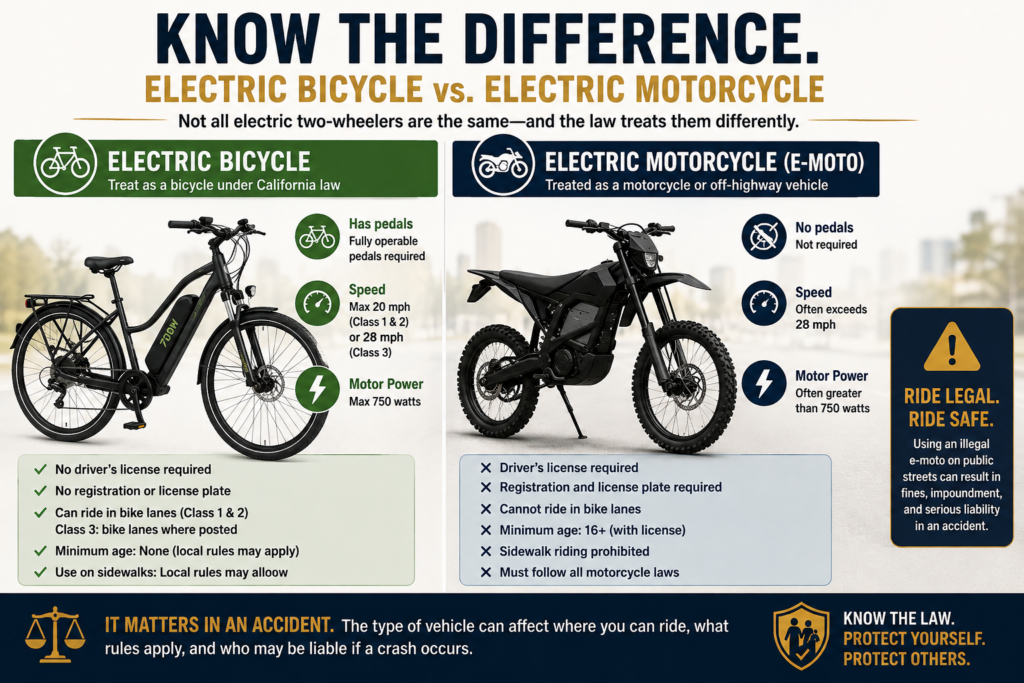
Under California Vehicle Code section 312.5, an electric bicycle must have fully operable pedals and an electric motor of no more than 750 watts. California recognizes three classes of e-bikes, with Class 1 and Class 2 generally limited to 20 mph and have no rider age or licensing restrictions. However, a Class 3 bike with pedal assistance up to 28 mph requires riders to be 16 years or older.
Furthermore, an electric bike that doesn’t qualify as Class 1, 2, or 3 is considered an electric motorcycle or e-moto. Any bike with an electric motor that exceeds 750 watts of power or can ride above 20 mph on motor alone is an electric motorcycle.
Also, a bike that has been modified to exceed the statutory limits, has its pedals removed, or was designed to be modified beyond those limits is not considered an electric bicycle under California law.
That distinction matters.
California Highway Patrol issued a 2026 bulletin specifically warning that some electric devices resemble e-bikes but do not meet the legal definition. California also created a new definition for off-highway electric motorcycles, or “e-motos,” effective January 1, 2026. Those vehicles are not legal for ordinary operation on public roadways.
In other words, a vehicle marketed online as an “e-bike” is not necessarily an e-bike under California law.
What About a Defective E-Bike?
Sometimes the problem isn’t the rider or another driver.
A defective component can potentially create a product-liability claim.
Potentially relevant defects may involve:
- Brakes;
- Tires;
- Batteries;
- Throttles;
- Steering components;
- Frames;
- Accelerators; or
- Electrical systems.
An investigation may need to determine whether the product was defectively designed, manufactured or marketed, or whether inadequate warnings contributed to the injury.
The vehicle itself should generally be preserved after a serious crash rather than discarded or repaired before the cause of the collision has been fully investigated.
Insurance Can Be Complicated
Insurance coverage for an e-bike accident is not necessarily as straightforward as automobile insurance.
California law specifically provides that an electric bicycle is not a motor vehicle and that e-bike operators are not subject to the state’s motor-vehicle financial-responsibility, driver’s-license, registration and license-plate requirements.
That means an injured rider cannot simply assume that there is an automobile insurance policy attached to the e-bike.
Depending on the circumstances, potential sources of compensation could include:
- The at-fault driver’s automobile insurance;
- Uninsured/underinsured motorist coverage, when applicable;
- A homeowner’s or renter’s insurance policy, depending on the circumstances and policy language;
- A manufacturer’s or seller’s liability coverage;
- Another responsible party’s insurance; or
- Personal assets of an at-fault party.
Insurance coverage must be evaluated based on the specific facts and policy language.
What Should You Do After an E-Bike Accident?
If you are injured in an e-bike or electric motorcycle collision, take the same basic steps you would after a serious automobile accident:
Call 911 and report the collision.
Get medical attention. Some serious injuries, particularly head and spinal injuries, may not be immediately obvious.
Document the scene. Photograph the vehicles, bicycle, roadway, traffic signals, injuries and surrounding area.
Get witness information.
Preserve the e-bike or e-motorcycle. Do not modify, repair or discard it if a defective product could be involved.
Preserve video evidence. Nearby businesses, homes, schools and traffic cameras may have footage that disappears quickly.
Do not assume the insurance company will determine who was responsible.
And if a child was operating the vehicle, determine exactly what type of vehicle it was. Whether the vehicle was a legally classified e-bike, a modified e-bike or an electric motorcycle can have significant legal consequences.
The Bottom Line for California Families

E-bikes are not toys, and high-powered electric motorcycles are not simply bicycles with batteries.
As these vehicles become more common, California is confronting a growing number of serious crashes—particularly involving young riders and high-speed electric vehicles. The Orange County case involving a teenage rider and a fatal pedestrian collision demonstrates how serious the consequences can become for both families and victims.
For parents, the lesson is straightforward: know what your child is riding, know whether the vehicle is legal, understand where the child is permitted to ride it, and do not assume that parental responsibility ends when you hand over the keys—or handlebars.
For victims, the question is equally important: Who is legally responsible for the injuries?
That answer may involve a negligent driver, an e-bike rider, a parent or guardian, a manufacturer, a retailer—or multiple responsible parties.
If you or someone in your family has been seriously injured in an e-bike, bicycle or electric motorcycle accident in California, an attorney can investigate the circumstances, identify potentially responsible parties and evaluate available insurance and other sources of compensation.
Johnson Attorneys Group represents injured people throughout California. Call 1-800-208-3538 for a free consultation.