Orange County E-Bike Case Puts Parental Responsibility in the Spotlight
September 2026
By James Johnson
The issue of parental responsibility received national attention following a fatal collision in Lake Forest.
According to prosecutors, a 14-year-old boy was riding a Surron electric motorcycle near El Toro High School in April 2026 when he allegedly struck 81-year-old Edward Ashman, a Vietnam veteran and substitute teacher. Ashman later died from his injuries.
The Orange County District Attorney’s Office subsequently charged the boy’s mother, Tommi Jo Mejer, with involuntary manslaughter and other offenses. Prosecutors alleged that the mother had previously been warned that her son was not legally permitted to ride the 2025 Surron Ultra Bee electric motorcycle. Nevertheless, she continued to allow him access to it.
The case is criminal, and the allegations have not been proven at trial. But prosecutors are throwing the book at the Aliso Viejo mother who faces seven years and eight months in prison if convicted.
Meanwhile, OCDA Todd Spitzer also filed child endangerment charges against a Yorba Linda father. The dad faces six years in prison if convicted on all counts. His 12-year-old son was critically injured when he ran a red light on a modified e-motorcycle and was hit by a car. These cases highlight a broader issue that California families should understand:
Parents can face consequences when they provide, permit or negligently supervise a child’s use of a dangerous vehicle.
The issue has become significant enough that the Orange County District Attorney has reportedly opened numerous investigations involving parents and children riding e-bikes and e-motorcycles.
Can Parents Be Liable If Their Child Injures Someone?
The answer is: potentially, yes—but parental liability is not automatic in every e-bike accident.
California Civil Code section 1714.1 provides that certain willful misconduct by a minor that causes injury, death or property damage can be imputed to a parent or guardian who has custody and control of the child.
As of July 1, 2025, the Judicial Council adjusted the statutory limit under section 1714.1 to $56,400 per tort. For personal injuries, the statute limits the imputed parental liability to medical, dental and hospital expenses within that statutory limit.
However, that does not mean $56,400 is automatically the maximum amount a parent could ever be responsible for.
There may be other legal theories, including claims based on the parent’s own negligence, such as negligent supervision or negligent entrustment. Those claims are different from simply imputing the child’s willful misconduct to the parent and can present substantially different liability questions.
What if the child simply made a mistake?
This distinction is important.
Civil Code section 1714.1 addresses willful misconduct, not every ordinary accident involving a minor. A child who makes a simple mistake while legally riding an e-bike does not automatically make the parent liable under that statute.
But the circumstances surrounding the accident matter.
For example, consider a teenager who:
- Has repeatedly ridden recklessly in traffic;
- Has been warned not to ride the vehicle;
- Uses an electric motorcycle on public streets;
- Performs wheelies or other dangerous maneuvers;
- Rides a vehicle that is illegal for the child to operate;
- Has modified the vehicle to reach substantially higher speeds; or
- Has previously caused dangerous incidents.
Those facts could raise questions about the child’s conduct as well as whether the parent negligently supervised the child or knowingly provided access to a dangerous vehicle.
Every case requires a fact-specific analysis.
What If a Child’s E-Bike Crashes Into a Pedestrian?
Pedestrian collisions are one of the most serious concerns involving e-bikes and e-motorcycles.
A rider who speeds through a crosswalk, ignores a traffic signal or fails to yield may be responsible for the resulting injuries. If the rider is a minor, investigators and attorneys may also examine the parent’s role.
Evidence can include:
- Who purchased the e-bike or e-motorcycle?
- Who owned it?
- Who paid for it?
- Was the child allowed to ride it?
- Did the parent know where the child was riding?
- Was the child legally permitted to operate that type of vehicle?
- Had the vehicle been modified?
- Had the parent previously been warned about dangerous riding?
- Were there prior traffic violations or crashes?
- Was the child wearing appropriate safety equipment?
- Was the vehicle being used on a public roadway when it was prohibited from doing so?
These questions can become particularly important when the victim suffers catastrophic injuries or dies.
The Bottom Line for California Families

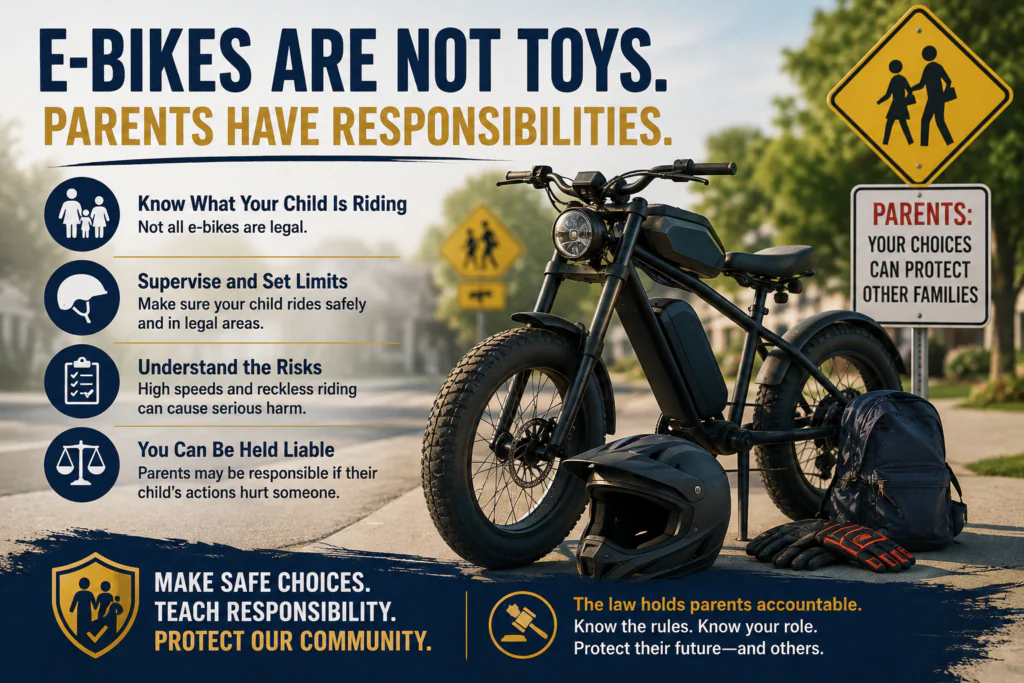
E-bikes are not toys, and high-powered electric motorcycles are not simply bicycles with batteries.
As these vehicles become more common, California is confronting a growing number of serious crashes—particularly involving young riders and high-speed electric vehicles. The Orange County case involving a teenage rider and a fatal pedestrian collision demonstrates how serious the consequences can become for both families and victims.
For parents, the lesson is straightforward: know what your child is riding, know whether the vehicle is legal, understand where the child is permitted to ride it, and do not assume that parental responsibility ends when you hand over the keys—or handlebars.
For victims, the question is equally important: Who is legally responsible for the injuries?
That answer may involve a negligent driver, an e-bike rider, a parent or guardian, a manufacturer, a retailer—or multiple responsible parties.
If you or someone in your family has been seriously injured in an e-bike, bicycle or electric motorcycle accident in California, an attorney can investigate the circumstances, identify potentially responsible parties and evaluate available insurance and other sources of compensation.
Johnson Attorneys Group represents injured people throughout California. Call 1-800-208-3538 for a free consultation.